
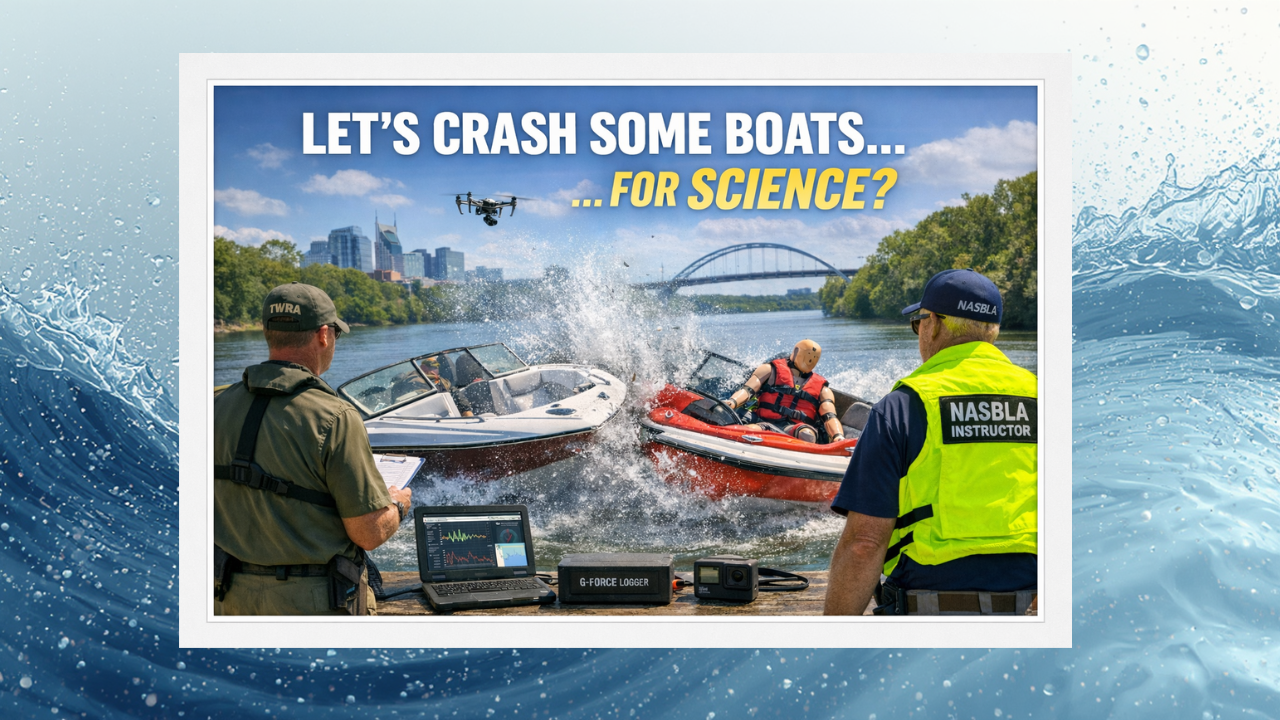
If someone casually mentions that a team is intentionally crashing boats this spring, it seems fair to pause.
But in this case, that pause will (hopefully) quickly turn into understanding.
This May, a multidisciplinary team of investigators, trainers, and technical partners will gather in Nashville to do something that looks chaotic from the outside but is, in reality, carefully planned, methodical, and long overdue: stage real-world boating collisions to improve how boating incidents are investigated nationwide.
Yes, boats will be damaged.
Yes, there will be dramatic video.
And yes…this is absolutely for science.
Why Crash Boats on Purpose?
Boating incident investigations are only as strong as the evidence investigators are trained to interpret. Yet for years, much of that training has relied on vessels that have sat outside, weathered by time and exposure, stripped of the subtle but critical indicators investigators rely on in real cases.
This project flips that model.
By staging realistic collision scenarios, like head-on impacts, crossing collisions, and T-bone events, the team can capture clean, high-quality data at the moment of impact: speed, angle, force, vessel response, operator position, and occupant movement. That data becomes a repeatable training asset mirroring real investigative conditions, raising the bar for incident documentation and reconstruction.
The result? Better training, stronger investigations, and more accurate reporting that strengthens boating safety across jurisdictions.
Funded Through a U.S. Coast Guard Nonprofit Grant
This effort is made possible through support from the United States Coast Guard’s National Nonprofit Organization Grant Program, a federal grant initiative that allocates a portion of recreational boating safety funding to nonprofit organizations carrying out national-scale safety projects.
NASBLA successfully secured this funding under that program, providing essential resources to support staged collision execution, data documentation, and instructional integration for boating incident investigation courses.
By aligning this project with a national grant program, the work not only advances investigative capability – it also contributes to sustained, measurable boating safety improvements on a national scale.
Built by People Who Know the Work
Projects like this don’t succeed on equipment alone. They succeed because the right people are involved…people who understand both the operational environment and the instructional end state.
The Tennessee Wildlife Resources Agency (TWRA) is hosting the project and supporting execution on the water. Lt. Colonel Matt Majors, whose experience spans field investigations and national-level training efforts, has been instrumental in planning, vessel preparation, and site coordination. His involvement ensures the collision scenarios are realistic, safe, and operationally relevant.
On the technical side, top tier industry partners are supporting high-fidelity data capture so investigators can study modern vessel systems – not outdated approximations.
But the connective tissue between the collision site and the classroom is experience.
Turning Impact Into Insight
That bridge is Mike Neal, NASBLA’s Program Manager for Boating Incident Investigation.
Mike brings decades of frontline experience to the project, having served more than 30 years as a Marine Conservation Warden with the Wisconsin Department of Natural Resources and as the state’s Lead Instructor for Boating Incident Investigations. As a NASBLA-credentialed instructor since 2006, he provides invaluable perspective on what works, what doesn’t, and what investigators actually need.
For this effort, Mike’s role is focused on ensuring that what happens during the collision becomes meaningful, usable training afterward by translating raw impact data into investigative lessons that reinforce proper documentation, reconstruction techniques, and analytical confidence.
Crashing boats is easy. Analyzing them correctly takes experience.
Informing the BOAT Program and National Standards
This project doesn’t exist in isolation. The findings will directly inform NASBLA’s Boat Operations and Training (BOAT) Program, strengthening boating incident investigation courses by grounding them in real-world, instrumented collision data.
It also supports NASBLA’s role as the organization that defines the standard for how boating incidents should be investigated and taught.
NASBLA maintains ANSI/NASBLA 500-2022: Investigative Training for Boating Incidents, the national standard created in accordance with, and recognized by, the American National Standards Institute (ANSI).
This standard defines how investigations should be conducted and taught, ensuring consistency and credibility in boating incident training nationwide.
The staged collision project provides the kinds of empirical, high-quality scenarios that help make that standard meaningful, classroom-ready, and defensible.
What We’re Actually Capturing
Each staged collision will be documented using investigative-grade methods, including:
- GPS and engine control data
- G-force and acceleration logging
- Anthropomorphic test devices to assess occupant movement
- High-speed cameras, GoPros, and drone footage
- Post-collision damage documentation and 3D scanning
This isn’t just going to be compelling video…it’s evidence designed to be studied, questioned, and applied in advanced training environments.
From the River to the Classroom
Once the collisions are complete, the damaged vessels won’t be discarded. They’ll become training assets used in NASBLA’s Advanced Boating Incident Investigation courses.
Investigators won’t be guessing what a fresh collision looks like. They’ll be walking around it, measuring it, reconstructing it, and comparing findings against known data – exactly the way investigations should be taught.
Serious Work, Light Entry Point…Because It Matters
The title may be playful, but the purpose is not.
Every accurate boating incident report contributes to smarter safety policy, better training, and, ultimately, fewer lives lost on the water. This project gives investigators the tools and confidence to meet a national standard and apply it consistently.
Sometimes progress requires doing the uncomfortable work on purpose –
so investigators don’t have to learn these lessons for the first time on someone else’s worst day.
Leave a Reply