
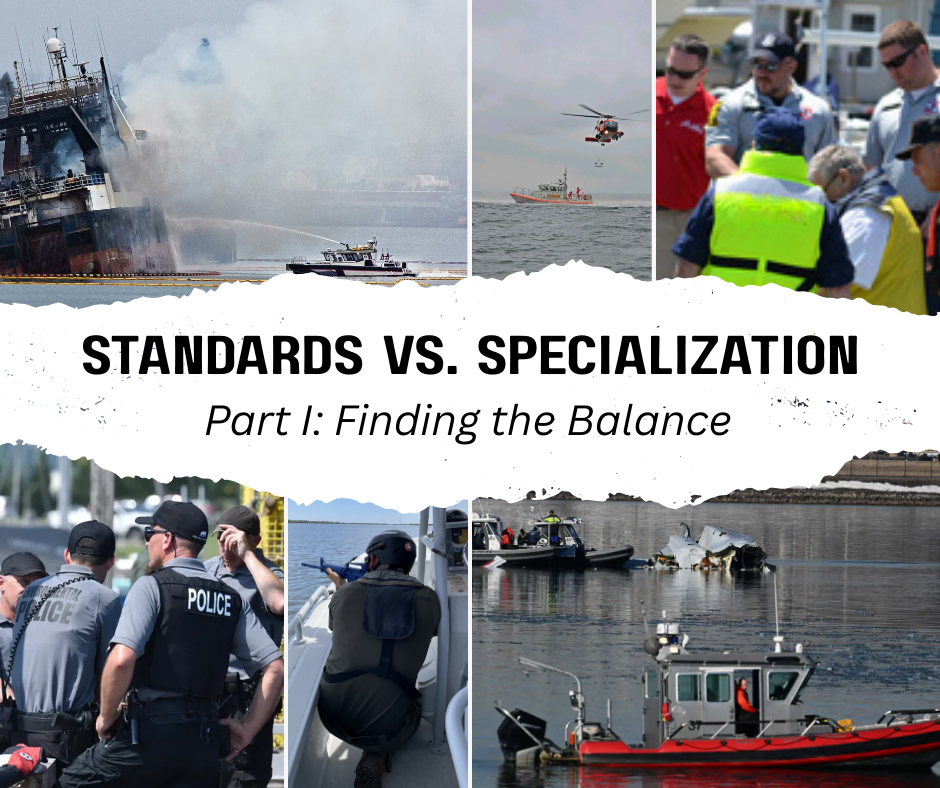
One of the most persistent challenges in first responder training is balancing the need for standardization with the reality of specialization. On one hand, shared protocols like common language, credentialing systems, and interoperable practices ensure that agencies can work together seamlessly. On the other, specialized jurisdictions face unique demands, from maritime law enforcement to firefighting, from natural resource policing to urban response, that broad frameworks alone cannot fully address.
I’ve seen both sides of this tension. National level initiatives lean heavily toward standardization, they create frameworks that apply everywhere so responders can move across jurisdictions without confusion. But in specialized environments, like the Coast Guard or state environmental police, the nuances matter. A one-size-fits-all approach can miss critical details, and those details can mean the difference between success and failure in the field.
The Case for Standardization
- Interoperability: When agencies respond together – whether to a search and rescue call, to secure a port, or command a mass casualty event – shared standards prevent miscommunication. A common operational language ensures that responders from different jurisdictions can coordinate quickly and effectively.
- Credentialing: Clear benchmarks ensure responders are trained to recognized levels of competence. Credentialing systems provide confidence that everyone on the scene has met the same consistent baseline requirements.
- Efficiency: Standardized systems reduce duplication and streamline training across regions. Instead of reinventing the wheel, agencies can rely on established frameworks and focus resources where they’re most needed.
Ultimately, standardization is about building trust. It reassures communities and commands that no matter who shows up – whether it be the local police, federal agencies, or specialized units – they’re all operating from the same foundation.
The Case for Specialization
- Context matters: Consider maritime operations from an inland perspective – they differ drastically from the coast. A responder trained for swiftwater rescue may not be prepared for open-ocean conditions, just as a firefighter trained for urban high-rise incidents may not be equipped for wildland fires.
- Jurisdictional needs: Local agencies face unique challenges that national standards might not fully capture. A coastal town may prioritize boating safety and hurricane response, while an inland community may focus on river traffic and cold-water rescue.
- Innovation: Specialized units often pioneer new practices that later have the capacity to shape national standards. What begins as a niche solution in one jurisdiction can evolve into a widely adopted best practice.
Specialization is about honoring the realities that exist out in the field. It recognizes that readiness isn’t abstract – it’s shaped by geography, community needs, and the specific risks responders face.
Finding the Balance
The solution isn’t choosing between standardization and specialization…it’s weaving them together. Standardization provides the foundation, while specialization adds the detail. The best systems I’ve seen are those that establish core competencies – the shared skills and knowledge that every responder must have – while also allowing flexibility for jurisdiction-specific modules.
For example, a national credentialing program might require proficiency in communication protocols, safety procedures, and incident command systems. From there, specialized tracks can address maritime boarding operations, hazardous materials response, or underwater search and rescue. This layered approach preserves interoperability without sacrificing relevance.
Why This Balance Matters
Readiness thrives at the intersection of standardization and specialization. Too much standardization risks oversimplifying complex realities, while too much specialization risks fragmentation and confusion. The balance ensures responders can work together across boundaries while still being prepared for the distinct challenges of their environment.
In practice, this balance looks like:
- A Coast Guard unit seamlessly integrating with local fire departments during a hurricane response.
- State environmental police coordinating with federal agencies on waterway security, while still applying their specialized knowledge of local ecosystems.
- Urban and rural responders sharing a common incident command structure, but adapting tactics to fit their terrain.
Closing Reflection
Training manuals will always emphasize standards, and rightly so. But the margins, the places where specialization lives, are equally important. They remind us that readiness isn’t only just about compliance; it’s about adaptability, context, and innovation.
As threats evolve and communities face increasingly complex emergencies, the need to balance standardization with specialization will only grow. The question isn’t which to choose, but instead how to continue integrating both to build systems that are universal yet adaptable.
At the end of the day, readiness isn’t defined by the manual alone. It’s shaped by the people who carry it, the environments they serve, and the stories they write in the margins.
Leave a Reply