
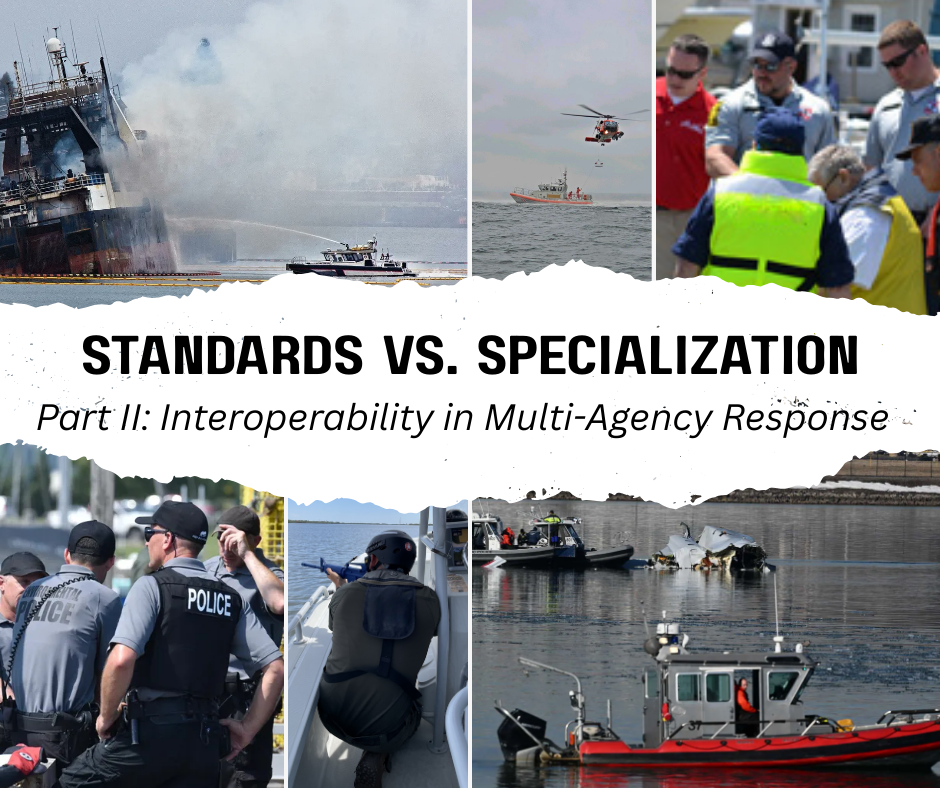
Interoperability in Multi-Agency Responses
When disaster strikes, what the public generally sees is uniforms, sirens, and rapid movement. What they don’t see, however, is the intricate coordination happening behind the scenes. Hurricanes, wildfires, missing-person searches, oil spills, mass-casualty incidents – each of these demands synchronized action from responders across different agencies, jurisdictions, and operational cultures.
It is in these moments that interoperability isn’t just a buzzword. It quickly reveals itself as the backbone of effective response. Over years of joint operations, training evolutions, and real-world incidents, one truth has become crystal clear – standardization isn’t a bureaucratic tool, it’s quite literally what transforms teams across different agencies into a unified system – ready to respond.
When an incident requiring a multi-tiered response occurs, agencies arrive on scene with different radios, equipment, mission priorities, and chains of command. Some responders operate daily in the field, while others surge only during crisis. Yet when these responders share a common baseline, things such as familiar ICS roles, standardized communications plans, credentialed competencies, and mutual expectations, those differences become assets instead of barriers. It’s important to remember that interoperability doesn’t erase individuality. It creates compatibility when it matters most.
Why Interoperability Matters
Interoperability exists where communication, capability, and trust intersect. And in emergencies, that intersection determines everything.
Why Communication? Because it creates clarity across agencies, platforms, and roles.
Emergencies compress time and miscommunication is one of the fastest ways for operations to stall. Interoperability ensures:
- Shared terminology
- Compatible radio plans and channel programming
- Smooth transitions into unified command
- Disciplined information flow
When responders are able to speak the same operational language then confusion dissipates while momentum accelerates.
Why Capability? Because it leverages strengths and reduces redundancy.
Interoperable training and standards are what allow agencies to plug into each other’s systems without hesitation. This enables:
- Scalable responses (local → regional → federal)
- Seamless integration of specialized units
- Efficient sectoring and task assignment
- Redundancy when one agency becomes saturated
Capability isn’t just about what each agency brings, it’s also about how well those capabilities are able to fit together.
Why Trust? Because it renders confidence in skills, judgment, and training.
Trust is the unspoken currency of emergency operations. When responders know their partners follow the same safety protocols, meet the same credentialing benchmarks, and operate under compatible doctrine, then they know that they can rely on one another almost instantly. That trust enables:
- Faster decision-making
- Smoother delegation
- Shared risk awareness
- Higher morale under pressure
When communication, capability, and trust converge, interoperability becomes more than a framework – it becomes an operational advantage.
A Story from the Field
When Hurricane Sandy struck the Northeast in 2012, the storm didn’t just flood neighborhoods…it reshaped entire coastlines. Channels that were once clear had suddenly become littered with wreckage, overturned vessels, submerged debris, and fuel spills. Thousands of boats throughout the region were either damaged or lost.
Within hours, a massive multi-agency effort surged across New York and New Jersey. Coast Guard units, local and state police agencies, port authorities, environmental response teams, and county partners mobilized to locate and mark hazards, clear access routes, conduct search-and-rescue, identify pollution threats, reopen commercial shipping lanes, and support relief supply and fuel movement.
Despite the complexity of the operation, agencies were able to integrate smoothly. Of course that wasn’t by luck. Shared ICS structures, NIMS-aligned processes, and exposure to national standards of maritime training meant teams entered the field with a common operating approach. Unified Command stood up quickly. Sectoring was established without debate. Communications flowed across vessels tied gunwale-to-gunwale.
In mere days, more than 6,000 waterway obstructions were identified and charted. Critical shipping lanes reopened far faster than projected. Because responders were interoperable from the outset, they weren’t out there wasting daylight sorting out terminology or authority – they were operational from the start. In the end, shared standards didn’t make the mission easier – they made it possible.
And the lessons from Sandy continue to echo in more recent multi-agency responses as well, from the hurricanes that struck Florida in 2024, to the unified salvage and maritime safety operations following the Francis Scott Key Bridge collapse in Baltimore, to the coordinated aviation and rescue efforts after the plane-helicopter collision in Washington, D.C. Each of these events underscores the same truth – interoperability is what keeps complex incidents from becoming chaotic ones.
The Margins of Interoperability
Standards provide structure, but incident environments also demand flexibility. Even the strongest national frameworks can’t fully account for the realities responders face on the ground. Terrain, weather, operational tempo, political context, and community dynamics shape decision-making in ways no standardized protocol could ever predict. That’s why effective multi-agency response requires an approach that respects both the consistency of standards but also the nuance of local conditions.
Interoperability isn’t about uniformity, it’s about compatibility. Standardization is what gives responders a shared backbone. Things like common terminology, predictable roles, reliable communication patterns, and mutual recognition of capabilities and qualifications. It ensures that when responders arrive from different agencies, they immediately understand how to plug into the system.
But it’s local adaptation and specialized skills that bring that system to life. On every incident, you see the value of specialized knowledge and context-aware judgment:
- A high angle rescue unit brings technical rope expertise and operational instincts that a coastal team simply does not need day-to-day.
- A local emergency manager contributes cultural fluency, community trust, and unique situational awareness that external agencies are unable to generate upon arrival.
- A federal strike team delivers depth, like logistics horsepower, surge staffing, and sustained operational endurance, something that smaller local units may not have the capacity to maintain during long-duration incidents.
- A harbormaster or local marine patrol officer can better recognize shifting sandbars, local currents, or weather patterns that may never appear in a formal briefing.
- A regional HAZMAT team may bring equipment and certifications that turn a local spill into a manageable incident within hours.
High-functioning operations don’t eliminate these differences – they leverage them. They create an environment where specialties are not only respected but intentionally integrated into the larger response strategy. Interoperability ensures that every skill set, from the hyper-local to the highly specialized, is able to connect smoothly within the broader system.
When standards provide the common operating framework and local adaptation provides the nuance, the result is a response network that is both stable and agile…something that is capable of scaling, adjusting, and absorbing complexity without losing cohesion. In the real world, that balance is what will separate coordinated operations from chaotic ones.
What Interoperability Really Builds
Efficiency matters. Speed matters. But the true value of interoperability lies much deeper than operational tempo. At its core, interoperability builds shared confidence, predictable collaboration, and trust under stress – the elements that are going to hold a response together when conditions are at their worst.
That trust, however, is rarely visible to the public, yet it can shape every moment of a coordinated operation. It shows up in the quiet, almost unnoticeable exchanges that allow teams from different agencies to move together as one.
- A radio call received without confusion because everyone is using the same terminology and structure.
- A safety warning recognized immediately because responders understand each other’s risk language and SOPs.
- A command transition executed cleanly with no debate over authority, roles, or expectations.
- A partner’s decision respected because their qualifications, training, and judgment are known and trusted.
- A coordinated maneuver underway before it has to be explained because shared doctrine removes the need for lengthy clarification.
These moments don’t make headlines, but they are what help make missions successful. And in the most challenging environments, it’s those “small” details that can become defining ones. They are what prevent hesitation, eliminate duplication, and create the space for responders to act decisively when it matters most.
Final Thought
While interoperability isn’t a technical requirement, it should be part of a professional culture. Standards provide the common ground. Experience fills in the margins. And together, they create a response environment that is cohesive and adaptable.
When agencies share training benchmarks, speak the same operational language, and understand each other’s capabilities, they don’t just coordinate – they integrate. And integrated responses are what save lives, safeguard communities, and strengthen trust across every jurisdiction involved.
Interoperability in the field is not rhetoric; it is the backbone of effective response that turns confusion into clarity.
Leave a Reply