
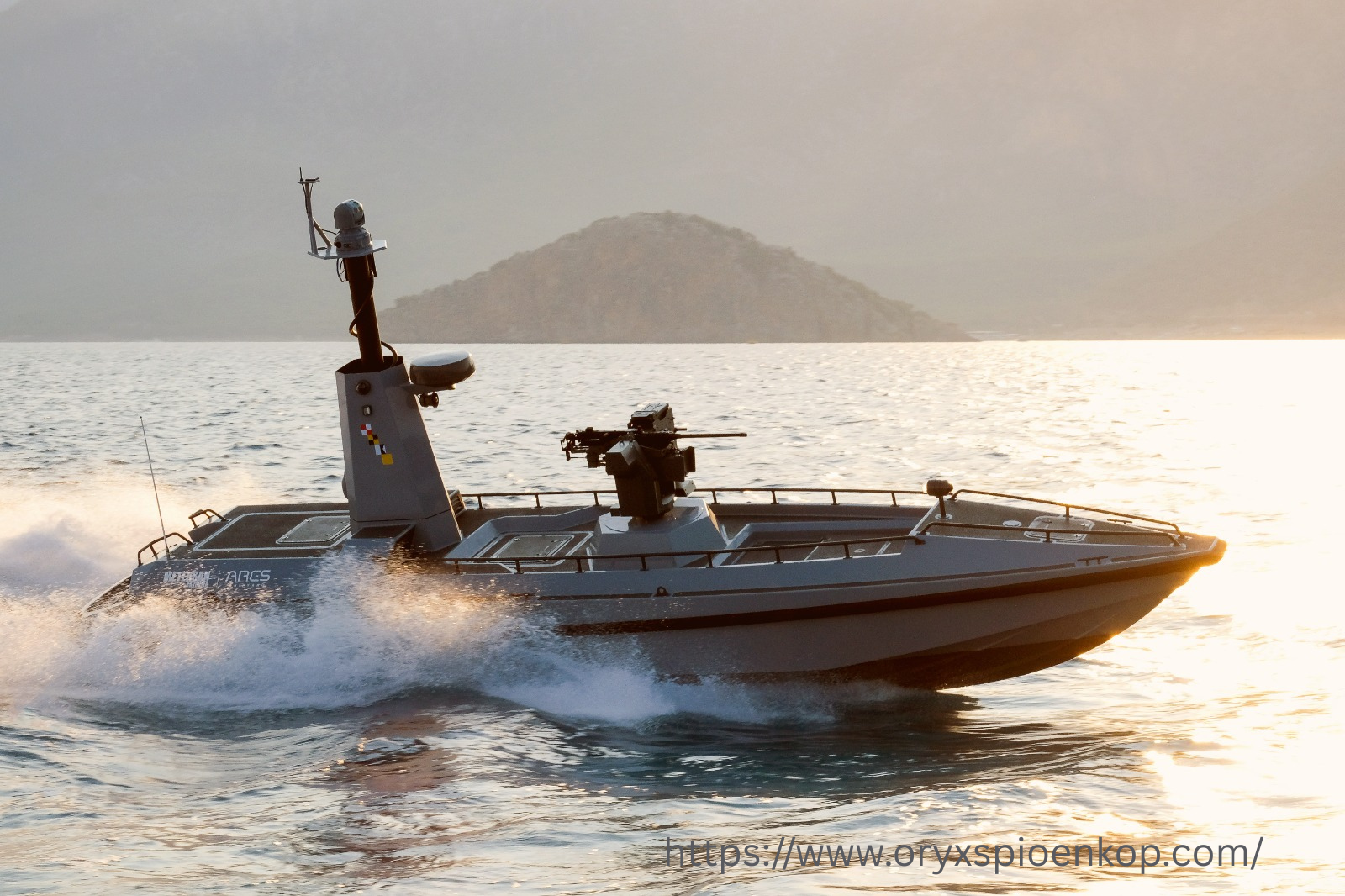
There is a familiar pattern in maritime operations, one where technology advances, the operational reality shifts, and doctrine follows…eventually. Unmanned maritime systems now sit squarely in the gap between what our manuals describe and what the operational environment increasingly presents. For OGAs and training organizations, much of our formal guidance still reflects yesterday’s assumptions, while our operational reality is already confronting tomorrow’s risks.
Unmanned surface vessels (USVs), unmanned underwater vehicles (UUVs), and autonomous platforms are no longer emerging threats – they are active participants, embedded either deliberately or opportunistically, across maritime security, commerce, and conflict. The challenge for maritime leaders, however, is not about simply understanding the technology, it’s about recognizing what the presence of these systems reveals about how the operating environment itself has changed.
As with every major inflection point in maritime history, the most consequential learning is not emerging from policy documents, it’s surfacing at the edges of practice, in real time, where new tools are altering risk faster than institutions recalibrate.
Capability as Context
Unmanned maritime systems are often framed as assets to be integrated, when in reality they are forces that will reshape our operational context.
The U.S. Coast Guard’s Unmanned Systems Strategic Plan outlines clear logic: persistent presence, expanded maritime domain awareness, and reduced risk to personnel. The logic is sound and the benefits are real; because persistent sensors do not fatigue, remote platforms do not require rescue, and data collection can scale in ways crewed patrols simply cannot.
But history also shows that when capability changes context, it also changes behavior…both ours and that of those who are watching us.
As unmanned systems become normalized in maritime security operations, they also become normalized as tools to be studied, replicated, and adapted by actors operating outside the law. This is not a failure of innovation but rather an expected consequence of it.
It’s important to recognize that autonomy does more than just extend reach, it also alters assumptions about risk, attribution, and response. When vessels are no longer carrying crews, the long-standing enforcement paradigms of hail, query, board, and inspect begin to strain. While the procedures will remain intact, their explanatory powers weaken.
Of course, this is not a failure. More so it’s the friction that naturally extends between our inherited frameworks and an operating reality that is evolving faster than the systems that were built to govern it.
Adaptation at the Edges
Recent instances are reinforcing a familiar pattern where our operational adaptation is not waiting for approval.
In the Red Sea, sustained attacks on commercial shipping by Houthi forces demonstrated how unmanned surface vessels can be used in layered, asymmetric attacks. The effectiveness of these attacks did not stem from being technologically advanced, but rather because the implements were both expendable and disruptive. Defense analyses noted that the value of these attacks were less about precision and more about the uncertainty they imposed on defenders.
In the Caribbean, the interception of an unmanned semi-submersible revealed that criminal organizations do not need fully autonomous fleets to gain advantage; they just needed to remove the human vulnerability that traditional interdiction relies upon. By eliminating onboard crews, criminal organizations have effectively neutralized one of law enforcement’s most reliable leverage points. The vessel itself was not the breakthrough; the problem it created for existing assumptions was.
In both cases, the systems didn’t necessarily break the rules, but they did operate outside of the mental models that the rules were built upon.
Where Existing Frameworks Begin to Strain
Port and waterway security has long relied on layered defenses built around human presence: visibility, interaction, and the ability to read human intent. Autonomous systems erode all three of those simultaneously.
A low-profile USV does not hail. A submerged UUV does not display nav lights. An autonomous vessel does not comply or resist in ways our procedures are designed to manage. The challenge isn’t just detection; it’s interpretation.
Another problem is that cyber dependencies compound this strain. These systems introduce failure modes that remain largely invisible until they manifest operationally. Research in maritime safety and cybersecurity literature consistently identifies GPS spoofing, signal interference, and remote manipulation as credible risks for autonomous platforms. Regulatory work underscores this reality, that the question is not whether autonomy is safe in principle, but whether institutions actually understand how control, responsibility, and intervention change when systems are distributed across networks.
For state and local maritime agencies, which are often the first to encounter anomalies, this creates a familiar leadership dilemma – that accountability arrives before fully aligned authority, tools, or training.
Leadership in the Gap Between Policy and Practice
One of the most consistent lessons across complex systems is that training often lags reality, not because leaders are inattentive, but because institutions are designed to stabilize, not pivot. Simply, systems are built to preserve what works.
Most maritime law enforcement training remains oriented toward crewed vessels and compliant interactions. That orientation is rational…until it isn’t.
Unmanned maritime systems demands a shift in emphasis. Leadership now requires acknowledging that unmanned maritime systems change not just what responders encounter, but how judgment is exercised under uncertainty. Decision-making is becoming less procedural and more diagnostic: Is this behavior anomalous? Is this platform compromised? What are the second-order effects of intervention or inaction?
Preparing for that environment means shifting training emphasis:
- From rote compliance checks to anomaly recognition
- From platform-centric tactics to manned–unmanned teaming
- From purely kinetic solutions to non-kinetic and cyber-aware responses
- From single-agency proficiency to interagency sensemaking
Simulation, scenario-based exercises, and joint training offer ways to surface these tensions safely, before they appear uninvited in real operations.
But what about policy? Performance is one metric, but policy needs to accommodate effective practice. Policy is what turns individual skill into organizational capability. It aligns authority with responsibility, it clarifies decision pathways, and it ensures that responders are not forced to improvise in the gaps between outdated guidance and these emerging realities. When policy lags too far behind practice, leaders are left navigating a two‑track system that leaves operators adapting in real time, with official guidance still describing a world that no longer exists.
Bridging that gap requires treating policy as a living mechanism…one that learns from the field, incorporates emerging patterns, and evolves at a pace that matches the operating environment. When policy and practice reinforce each other, organizations gain something essential: the confidence that their people are not only trained for the future, but also authorized to operate within it.
What This Moment Asks of Leaders
Unmanned maritime systems are neither inherently destabilizing nor inherently transformative. Their impact depends on how well organizations understand the space between capability and consequence.
The leadership question is not whether to adopt autonomy, but whether we are willing to adapt our assumptions alongside it.
That adaptation rarely announces itself loudly or arrives with great fanfare. It begins in small deviations from the manual, in lessons learned informally, in after-action discussions that reveal where procedures no longer fit the moment. Over time, those deviations become the seeds of new doctrine…so long as leaders are attentive enough to recognize them.
As with earlier shifts in maritime operations, resilience will belong to organizations that treat unmanned systems not as anomalies to be absorbed, but as signals that the operating environment itself has changed.
In an era where the operating environment moves first, this moment calls for leaders who can recognize change and act with purpose.
Leave a Reply