
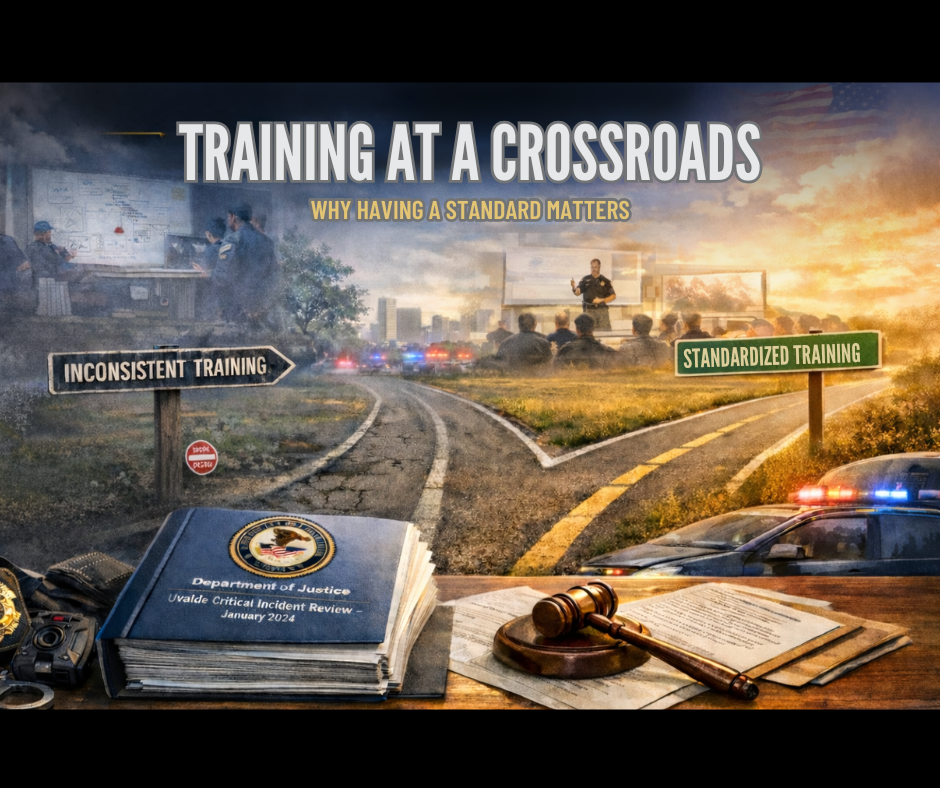
This weekend, while reading about another court proceeding connected to the Uvalde tragedy, my thoughts drifted back to the Department of Justice’s Critical Incident Review, released in January 2024. In 2024, almost any time I spoke at a conference or event, I talked about this review. At more than 600 pages, the report is exhaustive, it’s technical, and it’s often difficult to read – not just because of its length, but because of what it reveals. The failures at Robb Elementary were not the result of a single bad decision or one moment of confusion. They were the predictable outcome of an environment that lacked consistency, coherence, and shared expectations.
The DOJ’s review documents (in painstaking detail) breakdowns in communication, command, coordination, and decision-making…and those findings are now widely cited. What deserves equal attention, however, is what sat beneath those operational failures: training that varied significantly across agencies, doctrine that was interpreted differently depending upon the jurisdiction, and preparation that was uneven for the very type of event responders are trained to handle.
This is not solely an active shooter problem. It is a systemic challenge in how we prepare first responders nationwide.
The Hidden Cost of Inconsistent Preparation
The DOJ’s review makes it clear that responding agencies did not arrive at Robb Elementary with a common mental model. Expectations around incident command, transfer of authority, threat prioritization, and interagency coordination differed from responder to responder. These differences did not emerge in the moment…they were baked in long before the first officer arrived on scene.
Training shapes how responders interpret urgency, authority, and responsibility. When training is inconsistent, decision-making becomes individualized rather than collective. In high-risk, low-frequency events, that lack of alignment can be catastrophic.
Of course, these gaps in alignment didn’t show up overnight…and they’re not unique, nor are they limited. It reflects a broader national condition in which training is delivered through disconnected systems that are rarely evaluated as a whole.
A Parallel Warning From a Different Angle
Just one month before the DOJ released its Uvalde review, the New Jersey State Comptroller’s Office published its investigation into Street Cop Training, a private law enforcement training vendor with a massive national footprint. That report identified courses containing constitutionally impermissible practices, legally inaccurate instruction, and material that directly contradicted established standards of policing. In a four-year period, more than $1 million in NJ taxpayer dollars went to fund Street Cop training across the state’s police agencies, highlighting how easily problematic content can spread when it lacks rigorous oversight.
While the context differs from Uvalde, the underlying vulnerability is the same. Training, particularly when outsourced or informally adopted, can drift away from legal, ethical, and evidence-based foundations if it is not thoroughly vetted and continuously reviewed.
In this case, the issue was not fragmentation between agencies responding to a crisis. It was fragmentation between training content and the constitutional framework officers are sworn to uphold. Both failures point to the same systemic weakness: training too often operates without sufficient oversight, shared standards, or accountability.
A National Training Landscape (Without a Common Spine)
Across the United States, law enforcement and first responder training is delivered through a complex and decentralized network that includes:
- State and regional academies
- Federal training programs
- Private vendors and contractors
- In-house agency instructors
- Online platforms and distance learning
- Conference-style workshops and traveling seminars
Some of this training is exceptional…grounded in research, aligned with policy, and reinforced through realistic application. Some of it, however, is outdated, reflecting doctrine or case law that no longer applies. And some of it introduces operational and legal risk rather than actually reducing it.
The DOJ’s Uvalde review illustrates the consequences of this fragmentation. Responding agencies arrived with different interpretations of active shooter doctrine, different expectations for command and control, and different assumptions about who was responsible for decisive action. Scenario-based training varied widely, as did exposure to stress, uncertainty, and ambiguity.
When responders train differently, they respond differently. In routine operations, that variability may go unnoticed, but in a crisis, it compounds confusion.
The New Jersey Comptroller’s findings reinforce the same lesson from a different angle. When agencies adopt training because it’s popular, convenient, or persuasive – rather than because it’s accurate and aligned – problematic practices can scale quickly. Instructors with national platforms can influence thousands of officers, often with little visibility into the content at the agency leadership level.
The 12 Tenets of Training: A Corrective Born From Failure
In response to the failures identified in Uvalde, the DOJ brought forward The 12 Tenets of Training as part of its Critical Incident Review. These tenets were not aspirational guidance developed in isolation. They were a direct response to what the review revealed…an attempt to establish guardrails where none consistently existed.
At their core, the tenets force agencies to confront foundational questions they too often bypass:
- What operational problem is this training intended to solve?
- Is the content legally sound and grounded in evidence?
- Are instructors properly qualified, vetted, and evaluated?
- Is the curriculum current and routinely updated to reflect law and research?
- Does the training align with agency policy and real-world operations?
- Can the training be standardized where interoperability is required?
These questions are deceptively simple. They are also deeply uncomfortable, because they require agencies to move beyond check-the-box compliance and examine training as a strategic function.
The tenets recognize a fundamental truth: training that is compelling but unsound, tactical but misaligned, or innovative in form yet flawed in substance introduces risk at scale.
Training as a Cultural Engine
Training does more than transfer knowledge or develop skills. It shapes culture.
It influences how officers and responders interpret their authority, how they assess threats, how they interact with the public, and how they make decisions under stress. It establishes informal norms about what matters, what is tolerated, and what is expected when policy meets reality.
It’s important to remember that when training is fragmented, culture becomes fragmented. Units within the same agency can develop different assumptions about acceptable practice. Partner agencies can arrive at the same scene with different understandings of roles and responsibilities. Over time, these differences erode cohesion.
When training is inconsistent, performance becomes unpredictable. Leaders cannot assume that personnel share a common baseline of preparation, even when policies suggest they should.
And when training is unvetted, unconstitutional, or unsafe, then practices have an avenue to migrate quietly from the classroom into daily operations. By the time those practices surface, whether in complaints, lawsuits, or critical incidents, the damage is already done.
Lessons Repeated, Warnings Ignored
The Uvalde review demonstrates what happens when training fails to prepare responders for unified, decisive action. The Street Cop investigation demonstrates what happens when training actively contradicts constitutional policing and professional standards.
Different contexts. Same underlying failure.
Both cases underscore that training cannot be treated as an administrative afterthought or delegated entirely to external providers without any scrutiny. It’s one of the most powerful tools agencies have to shape behavior, decision-making, and legitimacy.
Raising the Bar Across the Training System
Improving outcomes requires more than just revising individual courses. It requires a whole structural shift in how training is governed, evaluated, and sustained.
That shift begins with several commitments…
- Vetting Every Training Provider
Agencies must examine instructor qualifications, curriculum content, legal accuracy, policy alignment, and evidentiary support before adopting any training. Charisma, popularity, or social media presence are not credentials. - Standardizing Core Doctrine Where Interoperability Is Essential
Shared doctrine enables responders from different agencies to operate cohesively under pressure. Standardization does not eliminate professional judgment – it provides a common foundation for it. - Eliminating Legally Deficient Instruction
Training that encourages unlawful practices or tactics is not merely problematic; it is institutional liability. Agencies must be willing to reject content that conflicts with established law, regardless of its popularity. - Prioritizing Realistic, Scenario-Based Preparation
High-risk, low-frequency events demand repetition, realism, and stress exposure that reflects operational conditions and not sanitized or theoretical exercises. - Aligning Training With Policy and Law
When training and policy diverge, responders are placed in untenable positions during real-world decision-making. Alignment is not optional, it’s essential. - Institutionalizing Continuous Review
Training must evolve alongside case law, research, operational lessons learned, and community expectations. Static curricula in a dynamic environment can quickly become obsolete.
Consistency Is Safety and Safety Sustains Trust
The DOJ’s Uvalde Critical Incident Review and the New Jersey Comptroller’s investigation may appear to describe separate failures, but in reality, they illuminate the same systemic weakness: a training environment that too often lacks consistency, oversight, and shared standards.
If agencies expect lawful, effective, and coordinated performance, training has to meet that same standard.
If interoperability matters, training cannot remain siloed.
And if public trust is a priority, training must reflect professionalism, legality, and accountability at every level.
Training is not a checkbox. It is the foundation of readiness, the backbone of organizational culture, and one of the clearest expressions of an agency’s values.
The crossroads is already behind us. What remains is whether the system chooses to raise the standard…or continue paying the cost of not doing so.
Leave a Reply