
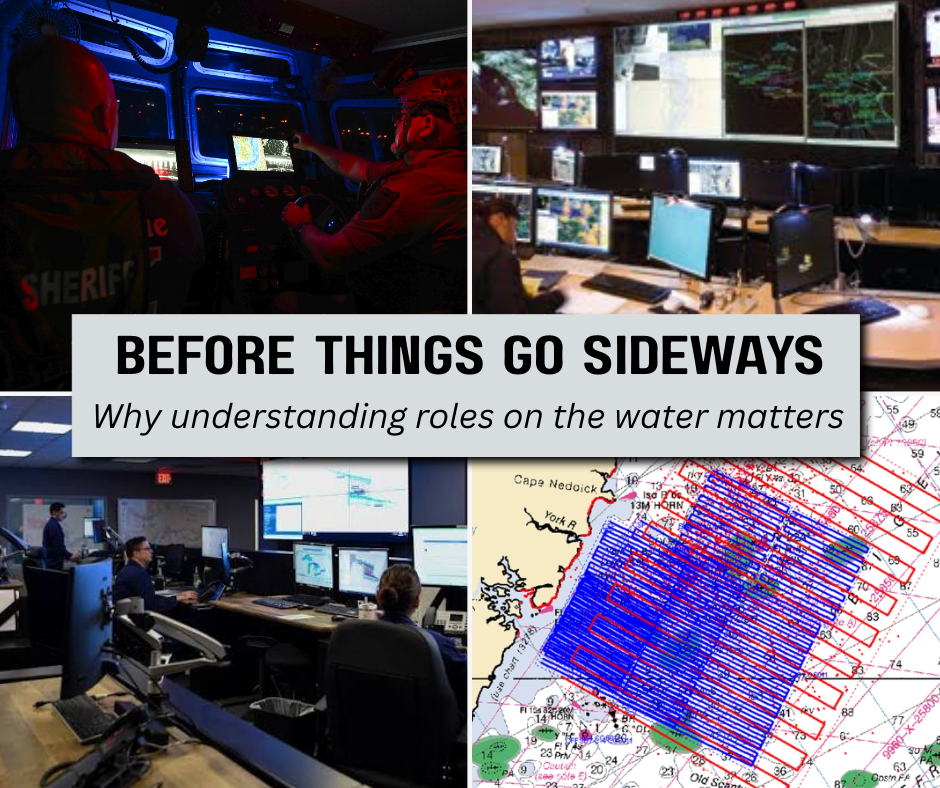
Maritime incidents have a distinctive way of exposing uncertainty more quickly than a lot of other public safety missions. When conditions deteriorate, information remains incomplete, and multiple agencies converge on the same stretch of water, a familiar question often emerges, (sometimes unspoken, sometimes asked aloud)…
Who, exactly, is in charge here?
On paper, the answer appears relatively clear. Jurisdictional boundaries and statutory authorities are defined. Incident Command System (ICS) doctrine outlines organizational structures and assigns roles, while memoranda of understanding sit in binders and shared drives, intended to provide clarity long before they are needed.
Yet when things go sideways…when weather worsens, communications falter, or an initial plan proves inadequate…those clean lines have a tendency to blur. Authority becomes ambiguous. Decision-making slows. And in the space between “someone should be in charge” and “someone is in charge,” risk expands quietly but meaningfully.
This dynamic is rarely the result of an individual leadership failure. More often, it reflects a systems-level challenge…one that maritime environments are particularly effective at revealing.
The Water Changes Everything
The unpredictability of the maritime environment is something I’ve written about a lot because it continues to complicate response, particularly for agencies whose operational foundations are rooted in land-based incidents. Assumptions that hold on roads or within buildings, such as stable perimeters, reliable communications, and predictable access, tend to dissolve once operations move onto the water.
Jurisdiction, in this context, is fluid…literally.
Vessels drift across boundaries. Rescue efforts transition from municipal harbors into federal waters without pause. Weather and currents influence movement more decisively than command intent, while responding assets arrive at different speeds, from different directions, and with different capabilities.
In these conditions, while authority must be clearly articulated, it must also be inherently adaptable. When it is not, hesitation fills the void, or decision-making occurs in parallel. Neither outcome is benign.
ICS Exists…But Maritime Command Is Also More Than an Org Chart
Most public safety agencies are familiar with ICS principles. Far fewer have applied them within complex maritime scenarios where uncertainty, environmental volatility, and interagency convergence are present from the outset.
Unified Command, while conceptually straightforward, becomes more complicated when agencies arrive with different operational cultures, varying risk tolerances, and distinct interpretations of what constitutes a lead role. In maritime incidents, command is seldom a singular function. Instead, it is a set of interdependent responsibilities that must operate both simultaneously and coherently.
This is often where friction first appears and where unanswered questions begin to bottleneck decision making.
Who is responsible for on-scene decision-making?
Who is coordinating the broader search effort?
Who is shaping strategy as conditions and information evolve?
Without a shared understanding of how these responsibilities align, agencies may hesitate to assert authority, or they may assume it in overlapping ways. Or worse, agencies focus more on who is in charge rather than the mission at hand. In these instances, uncertainty increases at precisely the moment clarity is most needed.
The Coast Guard’s SMC Role: Clear on Paper, Cloudy in Practice
Few roles illustrate the gap between formal clarity and operational understanding more clearly than the Coast Guard’s Search Mission Coordinator (SMC).
Within the Coast Guard, the SMC role is well defined. The SMC is responsible for planning, coordinating, and managing the overall search effort…assessing risk, prioritizing search areas, allocating resources, and adapting strategy as information changes. The role is strategic in nature, extending across agencies, jurisdictions, and time.
Outside the Coast Guard, that clarity often diminishes.
Local agencies may assume the SMC is synonymous with overall incident command. Others view the role as relevant only once federal assets arrive. Some encounter the concept for the first time in the midst of an active incident, often after early decisions have already shaped operational momentum. And, in some cases, others don’t even know it exists.
What is frequently missing is not effort or intent, but a shared understanding…particularly in the earliest phases of response. Actions taken before coordination is established often occur without a clear appreciation of how they align with a broader search strategy or how they may influence subsequent decision-making.
The SMC role does not replace on-scene command, nor does it override local authority. Rather, it provides a framework for strategic coordination that allows multiple agencies to operate toward a common objective without working at cross-purposes. When that framework is understood early, command relationships tend to reinforce one another. When it is not, well-intentioned actions can introduce unintended friction and risk.
The Cost of Courtesy and Assumption
Professional courtesy, while essential to interagency relationships, can quietly contribute to command ambiguity.
Agencies may hesitate to assert authority out of respect for partners. Leaders may wait for the perceived “right” agency to arrive. Crews may assume that someone else holds the larger operational picture.
This tendency is particularly evident when federal partners are expected. Local agencies may defer instinctively, even when federal coordination has not yet been established or when assets are delayed. Deference feels cooperative, yet in a dynamic maritime environment it can delay decisive leadership.
Command, in this context, is not about ownership…it is about accountability for decisions in real time.
When Command Is Unclear, Risk Moves Downward
When clarity is absent at the command level, risk does not disappear…it migrates.
It shifts to the coxswain navigating deteriorating conditions without clear intent.
It shifts to rescue teams making judgment calls in isolation.
It shifts to junior supervisors attempting to reconcile conflicting direction.
These individuals are already operating in a high-risk environment. Asking them to resolve ambiguity in command relationships in addition to executing tactical tasks is both unnecessary and preventable. Clear command structures protect responders as much as they protect mission outcomes.
Preparing for Coordination, Not Just Action
Maritime response training has traditionally emphasized tactical proficiency…boat handling, search patterns, recoveries, and survival skills. While these competencies are essential, they are not sufficient on their own.
The most consequential challenges often emerge not from a lack of technical skill, but from uncertainty about how decisions are made, how roles interact, and how coordination evolves as incidents grow in complexity. Developing familiarity with these dynamics before an incident occurs allows early actions to align with broader strategy, communication to improve as coordination expands, and transitions in command structure to occur with less friction.
When these understandings are first confronted during an active incident, the learning curve itself becomes an operational risk.
A Simple Question With Serious Consequences
“Who’s in charge?” is not a challenge to authority. It is a request for clarity.
On the water, uncertainty is unavoidable, but confusion about command doesn’t have to be.
The agencies that perform most effectively are not necessarily those with the greatest number of assets or the loudest presence, but rather it is those with shared expectations about authority, responsibility, and coordination…established long before things begin to go sideways.
Leave a Reply