
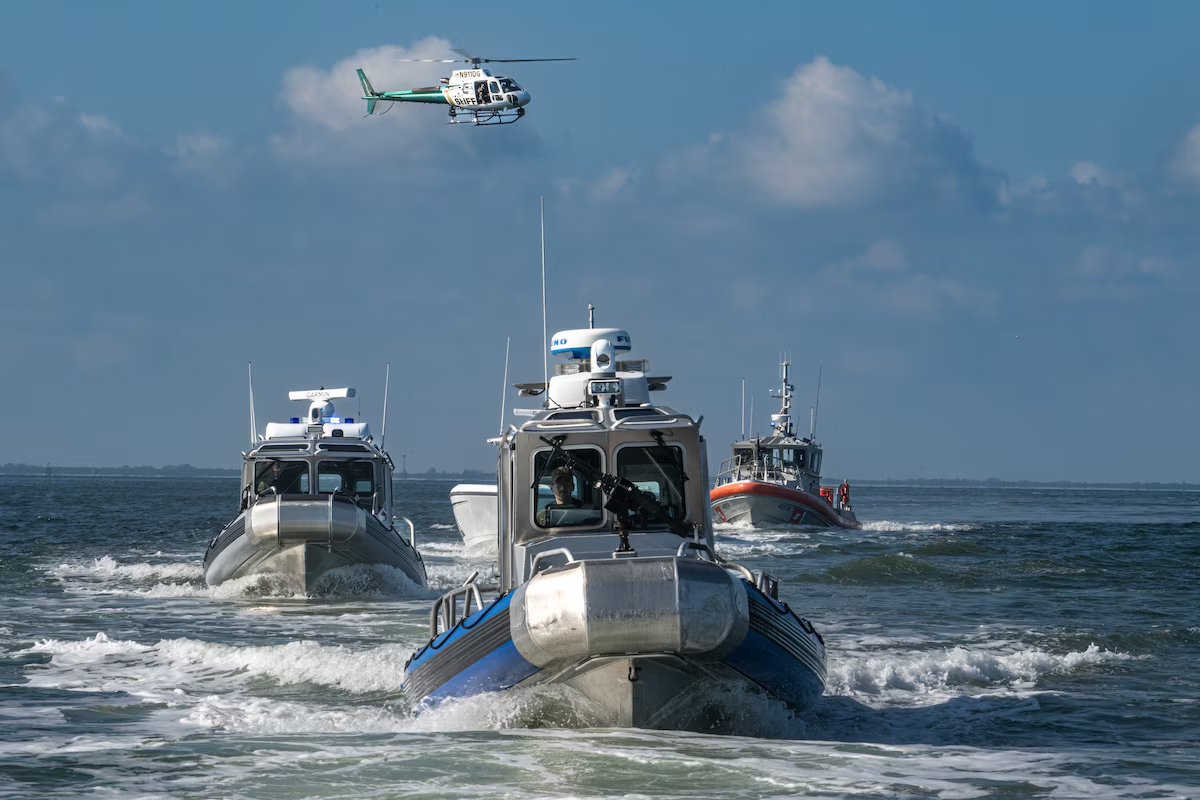
The maritime domain is unforgiving in one particular way: when something goes wrong, it rarely stays contained.
A vessel casualty becomes a search.
A search becomes a multi-agency operation.
A localized incident becomes a regional (or even national) problem.
And when that escalation happens, success depends less on who arrived first and more on whether everyone who arrived next can operate together immediately.
That is the core argument for a singular national standard of maritime training. Not as a policy preference and not as an academic ideal, but as a practical requirement for interoperability and force multiplication in an environment that no longer tolerates fragmentation.
Interoperability is Not Technology…It’s People
Interoperability is often framed as radios, systems, or command charts. In practice, it’s about something more basic: a shared understanding under pressure.
- How units maneuver in confined waterways
- How risk is communicated and managed
- How authority is transferred or shared
- How safety zones, search patterns, and on-scene command are understood
- How different uniforms execute as one team
Those things are not solved during an incident. They are solved (or exposed) by training long before the call comes in.
A national training standard doesn’t eliminate local expertise. It aligns it, making every qualified unit immediately useful to every other unit. That alignment is what turns a collection of responders into a force multiplier.
A Standard is Only as Credible as the Training Behind It
There is another uncomfortable truth in maritime readiness that often goes unspoken: not all training that claims alignment actually produces interoperability.
Many training entities can cite federal policy initiatives, doctrine touchpoints, or strategic priorities. On paper, they may “meet the requirement.” Operationally, the question is far more direct:
Does this training hold up when it meets real-world operations?
Who delivers the training matters just as much as what is written in the curriculum. Responders don’t just absorb procedures…they absorb judgment, risk posture, terminology, and culture from the instructors standing in front of them. If that instruction is disconnected from current maritime operations, joint response realities, or Coast Guard–partner integration, the result is often compliance without competence.
Sector Commanders and port partners intuitively understand this. Trust is built when training:
- Reflects how operations actually unfold on the water
- Uses language and decision-making consistent with federal and local response doctrine
- Is delivered by vetted instructors with credible operational experience across agencies
- Produces graduates who integrate smoothly, not tentatively, into joint operations
When training comes from a source that operational leaders recognize and trust, interoperability happens faster. When it doesn’t, friction shows up immediately…usually at the worst possible moment.
This is why a national standard cannot be separated from the credibility of those who deliver it. A shared baseline only works if the training behind it is respected by the very commanders and partners who will rely on it during an incident.
Interoperability is not just about checking a policy box. It is about whether, in the middle of a complex response, leaders trust that the units arriving on scene were trained by people who understand the mission, the environment, and the consequences of getting it wrong.
You Can’t Build Interoperability During the Crisis
The collapse of the Francis Scott Key Bridge illustrated a reality that maritime professionals already understand: interoperability is either present at the start of an incident or it isn’t available at all.
What began as a vessel casualty immediately expanded into a complex, multi-agency response involving search and rescue, port security, infrastructure coordination, and national-level oversight. Local, state, and federal organizations converged into the same operational space under intense time pressure and public scrutiny.
There was no opportunity to align terminology, reconcile procedures, or establish trust once operations were underway. Integration had to be immediate. That cohesion does not emerge spontaneously in the middle of a crisis…it only exists when agencies have already trained to a common standard and can operate together without hesitation.
Incidents that scale this quickly do more than test resources…they reveal whether interoperability was intentionally built beforehand or merely assumed.
Search and Rescue Exposes the Seams Fast
Major SAR cases are where the lack (or presence) of a shared standard becomes impossible to ignore.
Large searches expand geographically, operationally, and organizationally. New units arrive mid-operation. Command structures evolve. Fatigue sets in. Risk increases.
A common training baseline:
- Reduces friction when new assets arrive
- Accelerates operational integration
- Improves responder safety
- Preserves tempo over multi-day operations
Without it, every expansion adds drag. With it, expansion adds capacity.
That difference is force multiplication in real terms.
Ports Aren’t Just Local Problems
Ports sit at the intersection of commerce, security, and national resilience. They are not static facilities – they are operating environments that now face layered risks, from routine accidents to deliberate disruption.
The maritime domain itself is expanding: more traffic, more complexity, more overlapping missions tied to the emerging priorities of territorial integrity and border security. That expansion means more agencies operating in the same water space, often with different mandates but shared consequences.
Plans and frameworks exist to address this. But plans do not execute themselves. Trained people do. And people execute best when they share a common standard of practice.
Pressure is Already Scheduled
Unlike many threats, some of the next stressors are already on the calendar.
The FIFA World Cup 2026, associated fan fests, and maritime-adjacent celebrations will place dense crowds and heightened security demands along waterfronts.
The America 250 celebrations will drive large-scale commemorations across ports and navigable waterways nationwide.
These are not theoretical scenarios. They are known surge events that will require:
- Rapid multi-agency integration
- Maritime security operations alongside public safety response
- Immediate interoperability across jurisdictions
The question is not whether enough assets will exist. The question is whether those assets can operate together without hesitation.
You Can’t Surge Trust
When incidents expand, agencies surge people and equipment. What they cannot surge is shared understanding.
They cannot surge:
- A common language for risk and maneuver
- A shared expectation of how operations unfold
- Confidence that a newly arrived unit will operate predictably
Those things come from training to a common national standard.
That standard is what allows:
- Local agencies to serve as credible tactical partners
- Federal forces to integrate seamlessly with local knowledge
- Multi-agency responses to scale without losing coherence
It is what turns mutual aid into mutual capability.
One Team Requires One Baseline
The maritime environment will continue to evolve. Threats will change. Events will grow larger. Missions will overlap more frequently.
What cannot change is the requirement for responders – regardless of patch or platform – to operate as one team when it matters most.
A singular national standard of maritime training is not about control or conformity. It is about readiness, interoperability, and force multiplication in an environment where failure to align isn’t just inefficient – it’s dangerous.
Because when the next incident expands beyond anyone’s plan, the difference will not be how many agencies responded.
It will be whether they trained as one team before they ever met on the water.
Leave a Reply