
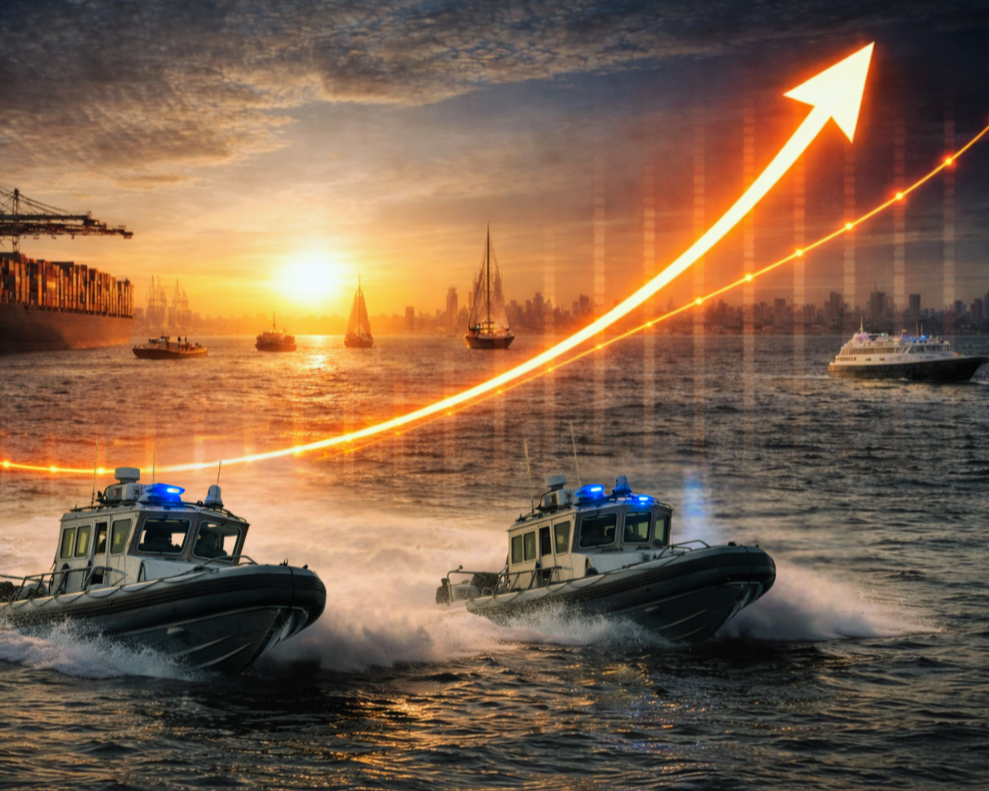
The Signal Is Already There
Across the maritime security and response community, the demand signal is becoming increasingly clear. Activity on America’s waterways continues to expand, expectations for coordinated response are increasing, and a series of near-term large-scale events will place additional demands on maritime security and response operations.
In many ways, this shift has developed gradually. Vessel traffic in busy ports continues to grow, while recreational boating remains strong across the country, and waterways that once supported modest activity now routinely host complex mixtures of commercial traffic, passenger vessels, and recreational use. As those waterways become busier, the expectations placed on responders have evolved as well. Incidents that might once have been managed within a single jurisdiction now often involve multiple agencies operating together in dynamic environments.
At the same time, the United States is entering a period where several large national and international events will place additional demands on the maritime system.
Over the next several months, maritime responders will support operational environments shaped by events such as:
- The 2026 FIFA World Cup, bringing millions of visitors to cities across North America
- America’s 250th anniversary celebrations, many of which will center around historic waterfront communities
- Sail 250, which will bring tall ships and naval vessels from around the world into American ports
- And continued preparation for the Olympic Games that will follow soon after
In some locations, these events will occur in close proximity to one another. In New York alone, planners have already described the operational environment expected in 2026 as the equivalent of hosting nine Super Bowls…at once.
That comparison resonates because it translates planning language into something tangible. Most people can imagine what it takes to secure and manage a Super Bowl. Multiply that operational complexity across several major events occurring in the same region and that magnitude becomes crystal clear.
Taken together, these developments represent a profound demand signal across the maritime domain.
This evolving operational landscape is also unfolding during a period of heightened global tension. Developments abroad, including instability in regions that influence maritime commerce and energy flows, continue to remind policymakers and security professionals that the maritime domain remains strategically significant. While these dynamics may not always be visible in day-to-day port operations, they contribute to a broader environment in which maritime security and response capabilities must remain adaptable and prepared.
The waterways are becoming busier…and the expectations placed on those responsible for protecting them are increasing as well.
A System Built on Many Hands
One of the defining strengths of maritime safety and response in the United States is that it operates as a distributed system. Capability is not concentrated in a single organization or authority. Instead, it exists across a network of federal agencies, state programs, local responders, port authorities, and operational partners who collectively safeguard the maritime environment.
This structure allows the nation to maintain maritime presence across thousands of miles of coastline and inland waterways; local agencies bring knowledge of their waters and communities, federal partners provide national coordination and strategic capability, and state programs help bridge those environments while supporting training frameworks and operational standards.
That system also supports a wide spectrum of missions. On any given day maritime responders across the country are responsible for boating safety enforcement, search and rescue operations, incident response, and the management of vessel traffic across busy waterways. At the same time, many agencies also contribute to the tactical and homeland security missions that protect ports, maritime infrastructure, and critical waterways.
These responsibilities often overlap. Responders may shift between public safety, operational response, and security missions within the same operational environment. The maritime system therefore depends not only on the capability of individual agencies, but on how effectively those agencies operate together.
Distributed systems are powerful…but they rely heavily on alignment.
When incidents occur on the water, responders from different organizations must be able to communicate clearly, understand each other’s capabilities, and operate with shared expectations about risk and mission execution.
As operational demand increases, that alignment becomes even more important.
What the Demand Signal Means in Practice
The phrase “demand signal” appears frequently in planning discussions, but its implications are worth discussing more directly.
In practical terms, the maritime community should expect to operate in environments that include:
- Larger public gatherings along waterfronts
- Higher concentrations of vessels operating in confined waterways
- Greater expectations for interagency coordination
- Increased complexity in maritime security and safety planning
- Continued tactical and homeland security responsibilities protecting maritime infrastructure
It is also important to recognize that these demands do not replace the daily operational responsibilities already carried by maritime responders. Ports will remain active. Recreational boating seasons will continue. Commercial traffic will move through busy waterways every day.
Agencies responsible for maritime safety and response will still be expected to meet those ongoing operational requirements while simultaneously preparing for and supporting large-scale events.
In other words…the demand signal is not marked on a calendar. It arrives layered on top of the operational tempo that already defines the maritime environment.
Training as the Foundation of Readiness
Operational readiness does not emerge simply because organizations exist. It is built deliberately through preparation, repetition, and the development of shared operational understanding.
Training provides the framework that allows responders from different jurisdictions to operate safely and effectively when they find themselves working together. It establishes common expectations around vessel operations, risk management, communication, and decision-making in dynamic environments.
In distributed operational systems, this shared understanding is essential. When agencies train within compatible frameworks and standards, they gain confidence not only in their own capabilities but also in the capabilities of the partners operating alongside them.
That confidence translates directly into operational effectiveness; communication becomes clearer, coordination becomes smoother, and responders are able to focus on the mission rather than navigating differences in operational expectations.
In short…readiness grows.
When Readiness Falls Behind Demand
It is worth acknowledging something that is sometimes left unspoken in discussions about readiness.
Operational demand rarely waits for readiness to catch up.
Large-scale events occur on their own timelines. Maritime incidents unfold according to conditions on the water, not according to training schedules. When those moments arrive, responders must rely on the capabilities that already exist within the system.
If training capacity and operational readiness fall behind the realities of the operational environment, coordination between agencies becomes more difficult. Responders may find themselves working together without the benefit of shared operational expectations or consistent training experiences.
Maritime responders also carry responsibilities that extend well beyond the high-profile events that tend to capture public attention. Tactical missions, homeland security responsibilities, search and rescue operations, and boating safety enforcement continue every day across the nation’s waterways.
When additional operational demands are layered onto an already active system, attention and resources can become diluted unless readiness and training capacity expand alongside them. The result is not a lack of professionalism or dedication from the people responsible for these missions…it is simply the natural consequence of asking the system to absorb additional complexity without increasing the capacity that supports it.
Recognizing that reality is not alarmist. It is responsible leadership and part of ensuring the system remains ready as the environment evolves.
Readiness Requires Stability
At the same time, the maritime community is navigating broader uncertainties that can affect the pace of readiness. Discussions surrounding Department of Homeland Security funding and the potential for government shutdowns introduce planning challenges for agencies responsible for training, coordination, and operational preparedness.
Maritime operations themselves do not stop during periods of fiscal uncertainty. Ports remain active, vessel traffic continues, and responders remain on watch. But disruptions to funding streams can slow training cycles, delay program delivery, and create uncertainty for the very systems designed to strengthen readiness across the maritime community.
Operational demand, however, does not pause for budget cycles. Major events, increased maritime activity, and evolving security considerations will arrive according to their own plans…reinforcing the importance of maintaining consistent investment in training and operational capacity.
Preparing Before the Moment Arrives
The increasing demand signal across the maritime environment should not be viewed solely as a challenge. It also presents an opportunity for leaders across the maritime community to strengthen the systems that support readiness.
Large-scale events, expanding maritime activity, and evolving operational expectations create natural incentives for deeper collaboration between partners who share responsibility for the nation’s waterways. Federal agencies, state programs, and local responders each bring unique capabilities to the system. It’s when those capabilities develop in isolation that opportunities for interoperability become limited. However, when they are strengthened through shared training environments and collaborative frameworks, the entire system benefits.
Training partnerships allow agencies to exchange lessons learned, refine operational practices, and build relationships that prove invaluable when real-world incidents occur. Over time those relationships create a stronger maritime response network…one capable of adapting to increased operational demand while maintaining the standards that keep both responders and the public safe.
The maritime domain has always required coordination between organizations with different authorities, responsibilities, and operational perspectives. What is changing is the scale and complexity of the environment in which those organizations now operate. The coming months and years will bring increased maritime activity, major international events, and heightened expectations for coordinated response across jurisdictions.
The maritime community has long demonstrated its ability to adapt to evolving challenges. The professionals responsible for safeguarding the nation’s waterways bring deep operational experience and a strong tradition of interagency cooperation. Recognizing emerging demand signals is not an indication of weakness…it is a reflection of a system that continues to assess its environment and strengthen readiness before challenges fully materialize.
Preparation today shapes performance tomorrow. In maritime operations, readiness is rarely something that can be built in the moment. When the moment arrives, the capabilities that matter most are the ones already built into the system.
Operational demand will continue to rise, and the question is not whether the maritime community will be called upon to meet it…
The question is whether the system will be ready when that moment arrives.
Leave a Reply