
One of our biggest goals before 2026 ended was to refine NASBLA’s Boat Operations Search and Rescue (BOSAR) curriculum. But when we started taking a closer look at it, there was one issue that was hard to get past…we were teaching a SAR course, but students were not really getting to the core SAR material until midweek.
So, maybe this was going to be a bigger lift than we initially thought.
There was good content in the course, but the flow needed work. We also needed to take another look at how we were spending our time with students and whether that reflected the equipment they use, the assignments they receive, and the situations they are preparing to encounter.
That matters from a learning perspective too. The people who attend BOSAR are learners who arrive with their own operational experience, agency procedures, equipment, and ways of solving problems. Andragogy has long emphasized that adults tend to learn best when they understand the relevance of what they are learning, can connect it to what they already know, and can apply it to real problems. For us, that meant asking whether the sequence of the course was helping students make those connections as early as possible.
Refining the course quickly became a much bigger effort than rearranging a few lessons…but it also became a much more collaborative one, which has honestly been one of my favorite parts of this process.
We have instructors volunteering their time to teach and review the changes, Coast Guard personnel helping inform and build modules, and partner agencies working through the material with us. Everyone is bringing a slightly different perspective, but there is a shared investment in getting this right that has been pretty incredible to watch.
Making Better Use of the Time We Have
One of the things we revisited right from the start was a manual charting exercise. Charting has value, and understanding navigation is still important. But when we looked at how the operators informing this redesign were actually working, including our Coast Guard partners, electronic navigation tools were a much bigger part of the picture.
That gave us a practical question to work through…were we spending enough time helping students use the equipment they would actually have in front of them during a search?
Now, we are shifting more of that attention toward electronics and connecting those tools directly to SAR assignments. Our interest is in helping operators become comfortable and confident with the equipment aboard their boats, and capable of using it when they need it most, rather than spending a disproportionate amount of our limited course time on an exercise that is less reflective of how they actually operate.
There is a learning-science argument for that shift as well, because training transfer matters. Being able to perform a task in a classroom is useful, but ultimately we care about whether someone can retrieve that knowledge and apply the skill later, in a different environment, while managing everything else happening around them. The closer we can connect learning to the tools, decisions, communications, and problems operators will encounter in the field, the more opportunity we have to build that bridge between course completion and actual performance.
That is also why we are particularly excited about the expanded scenarios on the water. Students will have greater opportunities to practice, receive feedback, make adjustments, and try again. Instead of introducing individual skills and assuming students will later figure out how to combine them, we can progressively bring those skills together in increasingly realistic situations.
Learning science consistently points to the value of practice coupled with meaningful feedback, particularly when people have an opportunity to use that feedback to improve subsequent performance. In an operational course, that matters. We are not trying to make complex SAR decisions automatic. We are trying to make foundational skills, equipment use, communications, and familiar processes sufficiently practiced so that operators are not spending unnecessary cognitive effort figuring them out when the situation becomes more demanding.
As we work through testing, we are fully invested in hearing where those opportunities are helping things come together and where we still need to make adjustments.
Building Alongside the Coast Guard
Another substantial part of the redesign involves terminology, acronyms, and radio communications, especially how operators understand and integrate into the Coast Guard SAR system.
We want the course to help connect what happens aboard an individual boat with the mission being coordinated around it. That includes understanding an assignment, making sense of the language being used, and communicating effectively with the people supporting the response.
That is another place where context matters. Memorizing an acronym is one thing. Hearing it during a scenario, understanding what it means, recognizing what is being asked of your crew, and responding appropriately is something different. The second is much closer to what we actually need operators to be able to do.
Having the Coast Guard involved while we work through those connections has been enormously valuable. In my experience, the level of engagement in this redesign has been unprecedented, and it continues to grow.
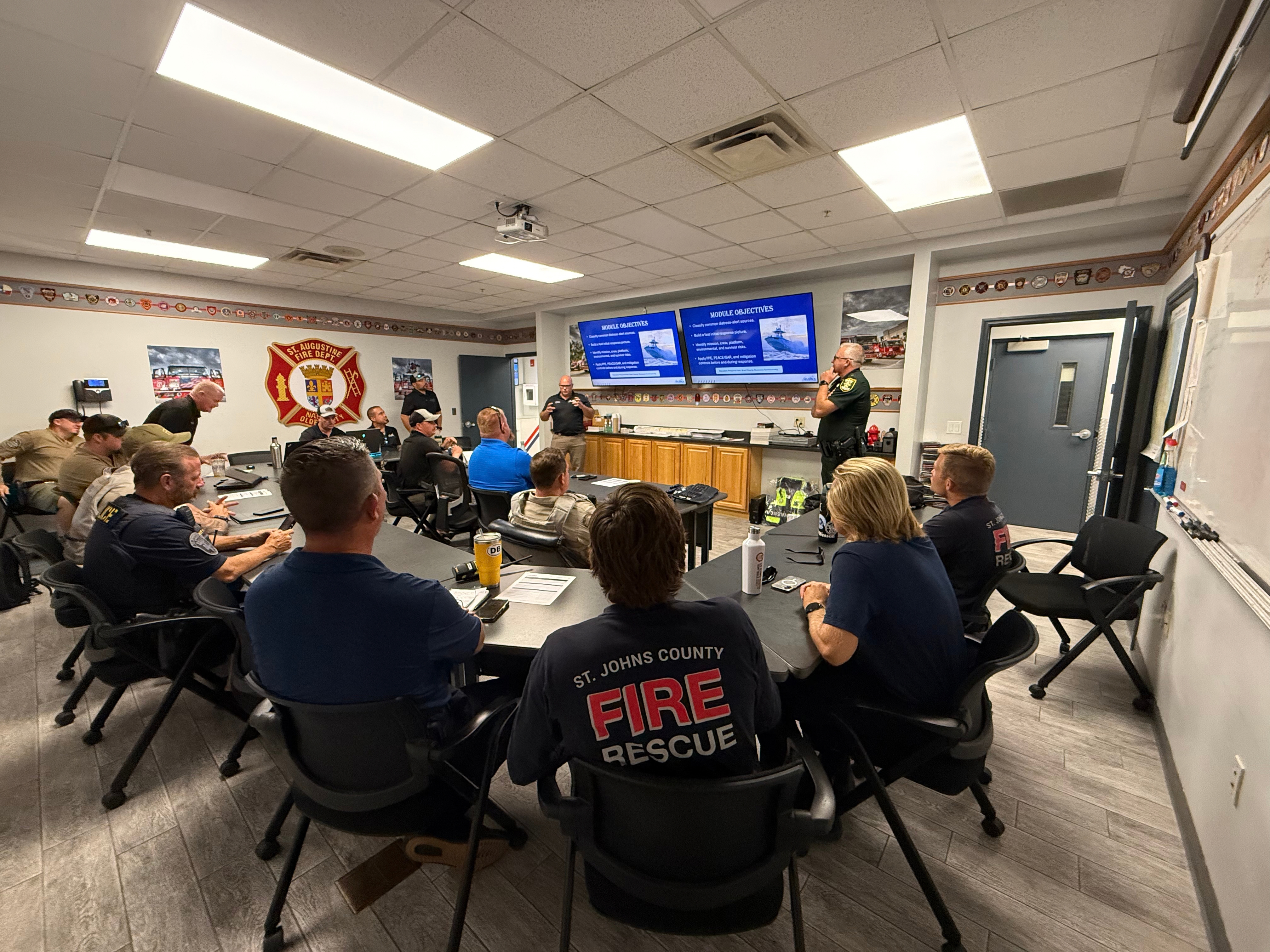
Coast Guard personnel participated alongside NASBLA and other agency partners in the workgroup held at Station Mayport this spring to help kick off the redesign. Since then, Sector and Station personnel have helped build modules, provided subject-matter expertise across the curriculum, and assisted with closed beta testing. They are working through the material with us while there is still room to question it, adjust it, and then see how those adjustments work in practice.
We are also receiving support from Coast Guard small boat stations to assist with local delivery. That gives us an opportunity to see how the course flows across our different delivery avenues, including station-supported instruction. It is important that we examine the curriculum in those different settings rather than assume what works in one delivery model will translate exactly the same way in another.
Our liaisons at USCGHQ’s Office of Boat Forces will also be participating in upcoming deliveries, contributing their feedback and operational insight as we continue refining the curriculum and growing the Program.
There is a tremendous amount of experience being brought into this effort, and I appreciate how willing people have been to share it.
The People Behind the Program
Our instructors are always unbelievably invested, including in ways that are not necessarily visible outside the Program, and this initiative is no different.
They have volunteered their time to instruct during the closed beta testing period, contributed feedback throughout the course design process, and continued engaging with students to help us understand whether we are meeting the mark. They are helping us deliver the course while, at the same time, helping us figure out how to make it better.
I do not take that lightly. These are people choosing to give their time and expertise because they care about the material, the Program, and the responders who will eventually depend on what they learn.
Their involvement matters immensely from a learning standpoint too. Experienced instructors see things that are difficult to identify on a lesson plan. They see where students hesitate, where an explanation does not quite connect, where a scenario asks too much too quickly, or where students suddenly begin putting multiple pieces together. That feedback loop between curriculum, instructor, student, and field application is incredibly valuable when we are trying to build training that transfers beyond the classroom.
The subject-matter expert leading the redesign has also been central to rallying that support. People are invested in him, and because this work matters to him, it matters to them. That personal investment has brought an incredible amount of energy into the process, and it has been encouraging to watch how readily others have stepped in to contribute.
Our partner agencies have brought a similar mindset. They want their personnel to learn, of course, but their interest has not stopped with the class being delivered at their location. They also want to know that when we leave and teach somewhere else, the next group is getting a product that meets the mark.
They are helping us improve something that will serve people they may never meet, at agencies they may never work with directly, because they care about the quality of the training and the success of the broader effort.
When we talk about “One Standard. One Mission.,” this is the kind of participation we have in mind. We are working on a course, but we are also strengthening relationships among people who want to be capable, dependable partners on the water.
Thinking Beyond the Last Day of Class
Some of our conversations have also extended beyond the curriculum itself and into how operators maintain those skills after training.
Our Coast Guard partners are helping us build our currency structures and refine the language explaining why currency maintenance is an important part of operator capability. I’m grateful that their involvement includes this piece because it connects closely to what we are trying to accomplish with the redesign.
We are putting considerable thought into what students should learn and how they should practice during the course, but what happens afterward deserves that same attention.
The learning sciences give us good reason to think that way. Learning is not permanent simply because someone demonstrated a skill once. Knowledge and skills that are not retrieved and practiced become harder to access over time, while spaced opportunities to return to the material, retrieve it, and use it can strengthen longer-term retention.
That makes currency more than an administrative requirement. When it is done well, it becomes a critical part of the learning continuum.
How do we help agencies understand what needs to be maintained? How do we create meaningful opportunities for operators to revisit those skills? And how do we make those expectations useful to the people responsible for keeping their crews prepared?
Those questions are all part of this same conversation.
Getting someone through a course matters. But we are equally interested in what they carry forward from it and what they remain capable of doing when called upon, because training completion and readiness are not the same thing.
Still Learning, Still Refining
We are still testing the material, gathering feedback, and making changes. I expect we will continue finding things that need attention, which is exactly why I’m glad so many people are willing to work through this with us.
In some ways, the way we are rebuilding BOSAR reflects the same learning process we are trying to create for our students…put something into practice, see how it performs, gather feedback, make an adjustment, and try it again.
We came into this knowing the curriculum needed work. What I have come to appreciate even more is just how invested people are in helping one another meet the demands of the mission. That has shown up in the Coast Guard’s expanding involvement, the time our instructors have volunteered, and the care our partner agencies are putting into their feedback.
I’m incredibly grateful to everyone contributing. We are building a stronger BOSAR course, but we are also strengthening the relationships and shared investment that make interoperability possible in the first place.
There is still plenty to do, but we have the very best people in the business helping us get there, and I couldn’t be more grateful for their support.
Leave a Reply